02 December 2025
Reddit to Revenue: Mining Customer Signals Using AI with Kay Allison (276) - S7E276
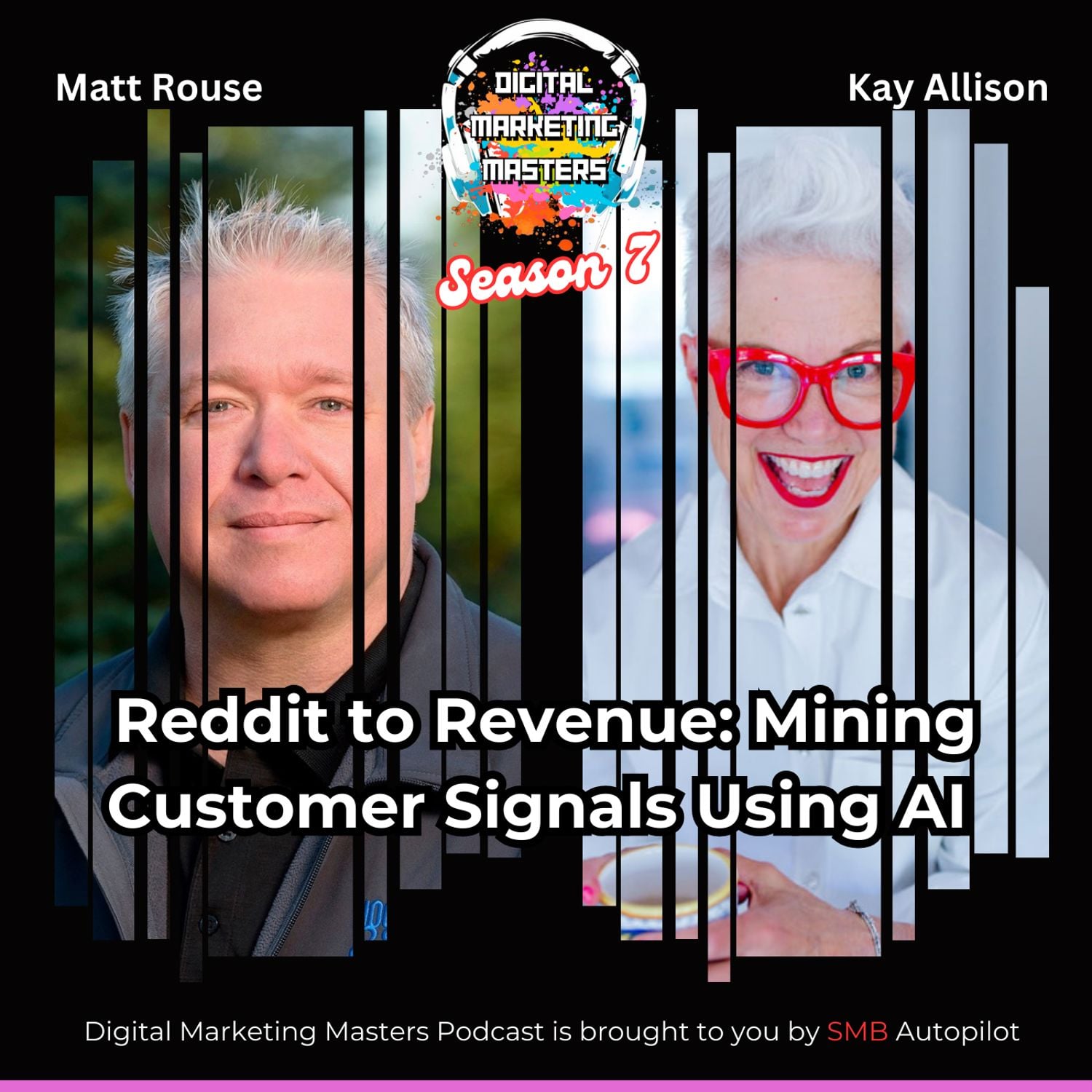
In this episode of Digital Marketing Masters, I sit down with product development and consumer insights expert Kay Allison to explore how AI can supercharge audience research and product innovation. We discuss why so many entrepreneurs (and big brands) mistakenly project their own preferences onto customers, how to recognize different decision-making styles and motivations, and the importance of uncovering real human conflicts—those tension points between what people want and what’s available. Kaye shares practical, low-cost methods to mine authentic customer conversations from Reddit, reviews, and social platforms, plus how to structure prompts for AI tools to identify segments, surface unmet needs, and turn messy qualitative data into actionable insights.
We also dive into advanced and “poor man’s” workflows: using Reddit’s Answers, exporting forum threads into docs, and uploading them to AI for synthesis; directing models to targeted sources and timeframes; and crafting context-rich prompts that specify role, data, output, and formatting. Kaye outlines a replicable prompt framework and offers her custom GPT for sorting customer data. We wrap by connecting these skills to broader problem-solving—from consumer research to complex health contexts—while emphasizing ethical use and the power of better questions to get better answers.
Kay: https://kayallison.com/
https://serve.podhome.fm/episodepage/digital-marketing-masters/276
(00:02) Opening and guest introduction: Kaye Allison
(01:27) Kaye’s one‑breath background and philosophy on consumer insight
(03:06) Entrepreneurs are not their customers: assumptions and humility
(04:28) Different decision styles and motivations beyond business growth
(06:13) Moving past basic AI use cases to learn your audience
(06:35) Mining Reddit and reviews; social listening with AI
(10:08) Hands‑on with Reddit Answers and broadening competitive sets
(11:32) Scrappy workflows: collecting posts and analyzing with AI
(12:07) Low‑cost tools, brand mentions, and what to ask AI
(12:32) Finding conflicts, segments, and gaps in consumer data
(14:10) Directing AI research: where to look and time windows
(16:01) Human nuance vs aggregates; walls around data sources
(18:36) Fragmented health data and DIY analysis with AI
(21:01) Asking better questions: from focus groups to prompting
(23:04) Context engineering and prompt structure best practices
(26:06) Non‑diagnostic framing and advocating with your doctor
(27:33) How to contact Kaye and her custom GPT offer
Looking for a podcast guest? Author Matt Rouse
Hook Digital Marketing | Hook Digital Marketing Canada
Market your local business on autopilot: SMB Autopilot
Looking for a podcast guest? Author Matt Rouse
Hook Digital Marketing | Hook Digital Marketing Canada
Market your local business on autopilot: SMB Autopilot
Today on the digital marketing masters podcast with your host, Matt Rouse. Our guest is the master of product development. Kay Allison.
[00:00:27] Matt Rouse:
Hey, everybody. Welcome back to Digital Marketing Masters. I'm your host, Matt Rouse. Today, my guest is Kay Allison. Kaye, how are you? Hey, Matt. I'm great this morning. How are you? I've already had a workout and a cup of coffee. I'm ready to roll. I wanted to have you on the show. We had a couple of conversations already. And you have two things that that really impressed me. One of them is your background. You have, you know, a lot of kind of shout outs, like customers that you had on, like, the Drew Barrymore show, and you negotiate a a series with Obama's production company and, other things like that, which is great. But the other thing is you and I had some great conversations already around kind of AI and product and knowing your audience. And I think one of the things that really stuck out to me is the way that you've kind of discovered how to use AI to learn more about your audience. Do you wanna maybe talk a little bit more about that? And and maybe first, why don't you give us, like, the one breath version of your background? Okay. I
[00:01:29] Kay Allison:
have always believed that business is nothing but a series of relationships through which products, services, and money flow. And because I believe that, we have to know the people that we're selling to. And so that is what I have done my entire life. I've always been fascinated by what makes human beings tick. And on the other hand, I'm an entrepreneur, and so I can listen to what makes you tick, and I can immediately see what you need or what I could create or what I could offer you that would make your life a little richer, better, easier, softer, gentler, more powerful, whatever it is you want. So my entire career has been spent in what we call consumer insights and innovation.
What that actually means is uncovering hidden desires and gaps and conflicts that customers are experiencing, and then figuring out how a client's client's brand, a client's company, a client's product can be positioned or what they could create to be able to address those things.
[00:02:37] Matt Rouse:
Nice. You've created some crazy products too and we'll get to that in a little bit. I'll leave that as a little spoiler alert for later that we're gonna talk about. But I think one of the most interesting things that I find is when we're talking with, you know, kind of smaller businesses and brands like small to medium sized businesses, I find that business owners almost always swear up and down that they know who their customer is. But if we were to survey them, it turns out that they don't. And I think there's a lot of disconnect between somebody who's an entrepreneur thinking that everybody who they serve also thinks like an entrepreneur. And they do not usually. No. They they rarely do.
[00:03:20] Kay Allison:
Actually, that is the mistake that marketers and big companies make too. We confuse ourselves with our customers. Right. And the biggest first step is to have the humility to admit that you are not like your customer and that they have agency and see the world very differently than you do. Everyone comes to every conversation with a set of assumptions and background and associations. The way that I make this point to my clients is I say, imagine a tree. And then I ask each one of them, what kind of tree did you see? And it's always everything from, like, a bonsai to a maple to a Christmas tree to a palm tree. Tree. And it's like, well, who's right and who's wrong? Nobody. We all just bring a different set of associations.
[00:04:10] Matt Rouse:
And I think that is what's so fascinating about being a human being and learning about others. I think another thing that's interesting along those lines too that rarely gets brought up in these conversations is that people have different decision making processes
[00:04:25] Kay Allison:
than somebody who is a business owner or manager would have. I was at an event just earlier this week. One of my friends was speaking at an all employee meeting for the sheriff's office in one of the local counties here in Colorado. Right. And she had us divide into, do you make decisions quickly or in a more measured process oriented way? And 85% of them were in the process oriented way, and there weren't that many of us in the other realm. So even that simple of an exercise just tells you that people are motivated by different things and they have different priorities. In fact, her talk started from the presumption that everyone is interested in improving them
[00:05:10] Matt Rouse:
getting ahead at work. And quite frankly, 90% of them were not so interested in either of those things. Right. Yeah. I think the motivating factors is a really interesting one. And we explored that a lot early on in our business, kind of actually when we started this podcast, which have been seven years ago now, almost eight. And I think what we found is when we started sitting down and having one to one conversations with our clients, which is something that we generally did, but it was always about the business. But when we started sitting down and having conversations about other things, we're starting to discover stuff like the real goal is not how much can I grow my business? It's, you know, how am I gonna set up a savings account for my kids to go to college, you know, or it was, you know, they have a hobby or something that they absolutely love that we know nothing about. Or, you know, some people are like, you know, say, oh, well, I have a, I have a difficult time making decisions about marketing because I like to plan everything out and no one's gonna happen before I start kind of thing. And that's not the way marketing works. Right? You know, 90% of the time. Typically not. But I wanted to catch also, I I mean, everybody's talking about AI now. Right? And I I know I've written two books about it as well. But the thing about AI right now is I think there's a very thin set of use cases that most people are doing with AI. And I think as you and I had talked about, there's a lot more people who could be doing to learn about their audience. Do you wanna talk a little bit more about how that could be done? Absolutely.
[00:06:37] Kay Allison:
One of the most amazing things that's available today is social media forums like Reddit and review sites. Right. And when you take advantage of reviewing all of the information in those sites, what you're listening to is what the human beings who are posting or commenting, they are devoting their own time and energy. They care about whatever their topic is so much that they are putting information out there about what they believe and what they like and what they hate and what's pissed them off and what cool thing they found Right. As opposed to the way we used to do it, which was to put people in a focus group room and pay them to answer questions about, say, mayonnaise for two hours. I promise you, none of those people cared enough about mayonnaise to be talking about it for two hours except the fact that they were getting paid. Right. So I actually think that what is available on these social media forums and review sites is actually more genuine than anything that is uncovered in a survey or in a focus group. So that's number one. I have access to a social listening tool. So what that does is it scrapes every conversation from all over all kinds of social media. And then I use AI to sort through those millions of posts about GLP ones or about olive oil or about bread or about whatever my clients are interested in, and I can sort them in a very specific way that I'll talk about in a little bit. So if you don't have access to that tool because it is expensive, if you go on Reddit, they have a new tab that down the left hand side called answers, and it's beta. But it uses AI to scrape every forum and every post and every comment on Reddit. And so you can go in and talk about real estate in New Hampshire or whatever whatever it is you're interested in, and see what Redditors are talking about, you can change the time frame that you're looking within and get a pretty good search of the hot topics that are trending and the things that people spontaneously care about. Not what they think about what you care about, but what they spontaneously genuinely
[00:09:08] Matt Rouse:
care about. Yeah. And it's not always positive, especially on Reddit. People don't have much filter on there. They're like, if they think something sucks, they are gonna tell you in no uncertain terms how much they think it sucks. Yeah. But wouldn't you rather hear that than people That's right. Upsetting you? Like, I Well, it's better to hear that than it is to, you know, like, put all your cash into launching something to know that it's gonna, you know, fall flat. Right? Oh my gosh, Matt. I did this focus group one once for a new product. It was a snack.
[00:09:39] Kay Allison:
And, you know, I gave samples to everybody in the focus group, and they're all chewing it and going, oh, yeah. It's good. And then I left the room to go talk to my clients in the backroom. Of course, they're watching through a one way mirror, and this lady pulls out a pack of gum. She goes, oh my god. That was horrible. Do you want a piece of gum? Get rid of that taste in your butt. Like, I'd much rather know that before I spend
[00:10:02] Matt Rouse:
millions of dollars launching something something and have somebody try to make me happy by being nice. Absolutely. You know what? I'm trying the the Reddit answers things right now while we're on here. Because I've poked around in there a little bit, but I haven't done too much. So I typed in AI podcasts for marketing, and, there's a few kinda showing up there's marketing AI show, which has actually been renamed to just the AI Show. That's Paul's one from the, Marketing AI Conference. Practical AI is a good one. Vergecast is a good one. Yeah. It's not bad. I gotta do some work. I gotta get myself in in the answers group for my
[00:10:38] Kay Allison:
podcast. You know, the other thing you could search for is how do I learn about AI and marketing? And so it'll show you a broader competitive set, if you will. And it's actually the competitive set the way your listener is
[00:10:54] Matt Rouse:
is considering it rather than narrowing it to podcast. Right. Yeah. That's excellent. And the other thing you had mentioned, you can put all this data in. If if you don't know how to do that, you don't have all the fancy tools you wanna do, like, kind of like you wanna hillbilly this together, all you gotta do is type in all the questions that you could think of around your topic into answers and just copy and paste all the stuff into a Google Doc and, you know, download it as a PDF, upload it into chat JPT, and ask your questions. Yeah. That's exactly right. So it's kind of a short short version. We used to call it back in the old days, called the the poor man's version of whatever it is. Right? How do you do it the the poor man's way? You absolutely
[00:11:33] Kay Allison:
can. I mean, you can even take screenshots of Instagram or TikTok and load it into Gemini or ChatGPT. There's all kinds of ways to do this. You don't have to spend $20 a year to do the social listening tool. Right. There are some social.
[00:11:51] Matt Rouse:
Listing tools that you can use that are pretty inexpensive that are, like, built into some of the social posting tools. I know, like, Hootsuite does it, buffer does it. And and they're not gonna pull the data to the degree that you're talking about, but they will pull it specifically about your brand. So if it's just about, like, mentions for your social media or your hashtag that you're following, it'll pull that kind of stuff. And then you can put that data in. But when I say we put that data into chat g b t, nobody I I shouldn't say nobody, but most people aren't gonna know what to type in after that. What do you think that they're doing? Are we, like, we're going into chat g b t five. We just put it on the thinking mode, and then what are we gonna upload our document, and then what are we gonna say? As I said at the beginning, what we're looking for are conflicts
[00:12:37] Kay Allison:
that your customers are experiencing. So a conflict between I want this one thing and I want that one thing that don't go together, and I want them at the same time. So for instance, you know, I love playing team sports, but I'd rather watch it on TV when Nike says go just do it. Right? It is a resolution of that conflict. And so what I will ask for is, you know, today you are an expert on looking for opportunities within consumer data. That's where I start. Right? What the mission is. And then I will set context. I have this kind of business. My customers, I think, are this. And, specifically, what I'm looking for is, are there groups different groups of consumers that are motivated differently in my category?
If so, what are they? And we're looking for five three to five different segments of consumers. And then within each one of them, where are the gaps between what's real and what's ideal, between when they wanna consume something and when it's available, and these conflicting desires,
[00:13:51] Matt Rouse:
and lay those out for me. First identify the segments and then for each one, tell me the most pressing conflicts that they experience. Excellent. Yeah. I think that's a fabulous place to start. You're gonna type those things in. You're gonna get some insights out of it. I think the thinking models also could go out and kind of do some of their own research as well.
[00:14:10] Kay Allison:
They you need to be pretty specific in the way you prompt it to do that. So if you're on Gemini or ChatGPT deep research, you need to tell it to go and look at TikTok and Reddit and review sites like Instacart if you're a grocery product or review sites, wherever that gets congregated for your industry. You need to tell it where to go. And look, you need to give it a time frame or it will default to either too long or too short of a time window. But, yes, you can absolutely
[00:14:45] Matt Rouse:
send it out to do those things. You might be able to get, you know, like with Gemini, you could probably send it to Google properties like Google Trends and stuff. It probably has more access to keyword data and things like that. I don't know how much I trust keyword data anymore, to be honest. That's just I don't have any data to back that up. I just know that looking at results like I have for the last twenty years, that if I look at some of the keyword data now, I'm like, that's just not true. I mean, it's based on Google search and how many people are using Right. But the search results search anymore But the reason that Google is being searched more is that the AI is searching it more, right? Regardless of which AI it is that they're using. And so there'll be like, well, we took the chat GBT data out. Okay. But you didn't take the other 27 AI's data. Right? Or all the tools that are automation tools that are using Python to search or, you know, like user agents and and all this kind of stuff. Right? There's all these technical reasons why Google searches would be up. The actual
[00:15:54] Kay Allison:
interface could be an AI system. Right? Absolutely. I I don't mean to go off topic too much. No. It's not human beings doing the searching. It's the agents doing the searching. Anyway, so I would honestly, I would trust that actually, my sense is that as data gets congregated, as the specifics of what a human being is posting gets congregated into big buckets or packages of things that go together, it dumps it down to a point where you don't get enough of the feel. You know? You don't get enough of the gestalt. It's like Right. Both people enough? It's not granular enough. Like, you know, I have my best ideas listening to actual human beings have actual conversations about this. Right.
Less so looking at big aggregates
[00:16:44] Matt Rouse:
of data. Right. I think another thing that's gonna happen, and this is also speculation, but I think another thing that's gonna happen is you're gonna get more places walling off their data from other AI systems. You know, like Reddit has cut a deal with, you know, I think Anthropic and OpenAI, right? So that they have, they could access the data, but they're paying for that access. But I think more and more places are going to start walling off their data. So you're going to have to go to each source separately, use whatever their tool is, and then use that to pull the data that you need. I think, you know, that absolutely works, and it goes back to your kind of poor man's approach to doing this. Copy and paste. Stick it all in a spreadsheet. Download the spreadsheet. It works just great. You know, another thing that's interesting I was I'm having a conversation along these same lines is tools that take your own personal data, but wall it off from you. Like, a good example would be and this is gonna come up in your research, so you can, you can make a consumer tool for this in the future. So let's say like I have a system that collects all my data through like a ring or my Apple watch or whatever that gets all of my medical data. And, you know, what they're not going to do is provide me a way to extract that data on a live basis, like an API or something so that I could use it with another system because they want us to buy their software and use their system.
If I have a ring from one company that checks my heart rate and stuff and I got my other one, my watch is doing all this other stuff and I got my glasses on that are also, you know, checking my eyeballs and my heart rate and all this kind of stuff and all that data is separate. There's no way to take all of the data from all the devices on an ongoing basis and have another system that maybe is kind of comparing all those things and saying, oh, dude, you better lay off this because you're gonna have a stroke or something. You know? Like, there's no way to kind of get consensus from your data when it's all walled off from each other. Oh my gosh. Matt, I have to tell you, one of my kids is chronically ill and bedridden chronically ill, only 22 years old, and has been for almost a decade. And it was a joint project. My husband uploaded
[00:18:50] Kay Allison:
every medical record we had from the time we adopted her when she was 11 old and had lead poisoning through last week. And she made this spreadsheet with all of her medical test results, the results, the reference range, the note, 15,000 cells. She handmade this thing. And I use Gemini to sort through all of this information, asking it, what's the theory of the underlying cause of all of this cascade of hell that she experiences? Do you know that it came up with a theory that it looks like she has a one in a million, literally one in a million condition
[00:19:33] Matt Rouse:
that is easily resolved, but I found it by using Gemini. It's it's amazing to me that you don't have access to all of your own health data in one place for yourself. We had to we had to assemble everything. I can't imagine what a a terrible job that would have been. It was a month. Like Like, my husband was like, I'm gonna work on this an hour a day, and it took him a month. Yeah. That's crazy. Your all your health records should be in, like, one place, and you should just, like, hit the download button. You know? Not the way it is. Maybe with your fingerprint or something. But, you know, another thing and now that we're on the medical subject, we have a client. Is a company called Metabolomics.
Oh, okay. And that's with a y at the end, Metabolomics. They do metabolite testing. They are just starting doing testing. Like, we help them format the report that they're gonna use to give to people after they do testing. They test the smallest amounts of metabolites that have ever been tested commercially available. So you can have your doctor basically order this test. I don't know what the cost is. I know it's under a thousand dollars but they can find out stuff that a doctor would never kind of think to test for because they don't have a condition that would make that the need to test for that. Yeah. And so sometimes they can determine underlying kind of hidden underlying medical conditions based on the amount
[00:20:55] Kay Allison:
or lack of amount of certain metabolites. It's pretty amazing stuff that they're viewing right now. Fascinating. I mean, the point is this. You know, it's all in being clever about the questions you ask. Right. For instance, when I first ask, you know, what's going on? Dada dada. What's the underlying cause? And it wouldn't do it's like, no. No. I'm not a medical doctor. Right. Blah blah blah. But when I ask, could you give me five different theories to explain the underlying cause, it generated five theories. And and the same thing was true when I was a focus group moderator. You know, I I moderated focus groups for Fortune 500 companies all over the world. I think I've probably interviewed 10,000 people from Western China to Paris to Right. You know, Kansas City. And it's always about asking clever questions and listening not for your for and through your own filters, but trying to discern what their filters are. And I think that that training as a focus group moderator made me good at prompting. It's the same kind of curiosity.
For example, when I would I did a lot of work for food companies, and I would start by saying, what's your philosophy of the care and feeding of your family? Right. You know, for for some moms, it's I need to protect my kids from the evils of sugar for as long as possible. You know, like, when I asked that question first, it helped me understand the context of everything else that that person was going to say, and it helped me understand the differences in their opinions. And so in the same way, when I'm prompting for my clients and and tell me about, you know, the consumer of of packaged bread in a grocery store, I wanna know what's their philosophy of feeding their families. It's why I asked Gemini what's the theory of what's going on here? Like, I always wanna know what's the context.
[00:23:04] Matt Rouse:
I should mention this is not medical advice. Always listen to your doctor. Don't use the AI as a doctor. But also, I wrote in my book, will AI take my job too? One of the most important uses of AI now that most people never saw coming is being able to be a part of your own healthcare. Because now you can ask all of the medical questions to the AI and say, what does this term mean? They're gonna use this treatment. Why are we using this treatment? Where's the data that backs up using this, you know, drug for this treatment or whatever. Right? So you can actually now be a part of it. And you can also say, what things, you know, what things maybe the doctor asked me this question this question. I have these symptoms.
What do you think the doctor didn't ask that, you know, might be important here? And so you can kind of also help build a case for yourself so you can advocate for yourself or for, you know, in your case for someone else. When you go to the doctor and you can say, you know what? I wanted to mention that symptom and this symptom, but also, you know, this may not be relevant, but I also have x y z. Yep. Absolutely. And, again, it's all in how you prompt. Right? It's all about Yeah. Well, and context. Right? Context engineering is it's the new prompt engineering. Right? It's Yeah. If you give the system enough context and data, and also, I think it's important to understanding longer prompts, but when it comes to something like medical, you don't want it to lose the plot. You know? I'm very clear about labeling
[00:24:37] Kay Allison:
each part of my prompt. Here's the context, and then I write the context. And, also, see attached blah blah blah blah blah. Right? Here's your role today. You are an expert at. Here's how here's the data I want. Here's what I want from you, and here's how I want it formatted. And then I always ask before first, before you do anything, tell me how to improve my prompt. Yes. You can also ask it. You can have it ask you clarifying questions.
[00:25:06] Matt Rouse:
Yep. But you can also have it, like, take your prompt and say, I don't want you to act on this prompt, but this is the prompt that I'm building, and this is the result I'm trying to get. Do you have any suggestions for improvement, you know, like you're saying? But that's a good way to do it without the it taking action on your prompt immediately. So, yeah, I mean, there's ways to do it. And, I mean, yeah, we're getting a little out of the out of the idea of audience finding know your audience, but I think it's it's important to know this is a great way to prompt your systems, and you're gonna use the same ideas whether you're doing audience research or if you're trying to find out whatever it is that you're trying to do. Right?
[00:25:43] Kay Allison:
It's very, very important to be clear about the context, the role, the specific request, how you want it formatted, and to ask before it does anything to help Right. You improve your prompt. Those have been the keys for me, whether I'm helping my daughter with her situation or whether I'm I'm creating a consumer segmentation for a client. Hey. You know, another thing that's interesting because, you know, we do work in in the private medical world and medical research world. There's the idea of not diagnosing
[00:26:16] Matt Rouse:
when you're reporting. If there's not enough of XYZ or there's too much of whatever it is, we know that this suggests this condition, but you don't want to do that on your report because you don't want to be the diagnostic person. That's the doctor who ordered the report is the di one who's gonna make the diagnosis. Right? So when you're talking to your AI system, you can say, I'm not trying to diagnose this condition. What I'm trying to do is determine what are the possibilities based on the data that we've given so that when I go see my physician, I can give them a better idea what we're looking at and what to look for. And so I can advocate on my own behalf to try and ensure that we get the correct treatment the first time, you know, so there's ways that you can talk to the AI about it.
And and you're being completely honest. You're not, like, tricking it into, like, being a doctor. You're just trying to say, look, I'm gonna go to the doctor. These are the things that are I think are wrong with me. Here's my symptoms. What else should I know to tell them? Right? Absolutely. Yeah. K. I think we've got we got a great prompt and and a way to collect data for people to learn more about their customers or to make new products and things like that. We learned about how to not use medical advice on our podcast. So if people wanna reach out to you, they wanna learn a little bit more. What's the best way for them to get ahold of you? So the best way to get ahold of me is on LinkedIn,
[00:27:36] Kay Allison:
k Allison. I will say that if you DM me custom GPT, I will send you a link to my custom GPT that will help you sort through any customer data that you have. Even if it's a poor man's, you know, Google spreadsheet that you've collected yourself, if you use my custom GPT and attach that, it will come back with the answers you want, so you don't even have to be an expert in how to prompt.
[00:28:03] Matt Rouse:
Nice. Alright, Kay. I appreciate you coming on today, and I hope that things work out with your daughter's condition. I hope they can find the underlying cause. Thank you, Matt. Thanks for the opportunity. It was great being here. I'm feeling
[00:28:18] AI Narrator #1:
lost. What's coming next? The world is changing. It's so complex. Will AI take my job? Will I be replaced? I'm just a cog in this corporate race.
[00:28:43] Narrator AI:
Don't you worry what's going on. And, hey, I even wrote and sang this song.
[00:29:19] AI Narrator #1:
Are high. I'm scared of it all. With every page, you'll
[00:29:24] Narrator AI:
find your way. Don't let fear keep you at bay. Don't read the book. Buy that to understand AI to join the dance. That's the spirit. Let's dive right in. The future awaits. Let the A book by Matt Rose. Discover the future of AI today. Today. Find the book. Buy the
Opening and guest introduction: Kaye Allison
Kaye’s one‑breath background and philosophy on consumer insight
Entrepreneurs are not their customers: assumptions and humility
Different decision styles and motivations beyond business growth
Moving past basic AI use cases to learn your audience
Mining Reddit and reviews; social listening with AI
Hands‑on with Reddit Answers and broadening competitive sets
Scrappy workflows: collecting posts and analyzing with AI
Low‑cost tools, brand mentions, and what to ask AI
Finding conflicts, segments, and gaps in consumer data
Directing AI research: where to look and time windows
Human nuance vs aggregates; walls around data sources
Fragmented health data and DIY analysis with AI
Asking better questions: from focus groups to prompting
Context engineering and prompt structure best practices
Non‑diagnostic framing and advocating with your doctor
How to contact Kaye and her custom GPT offer