
Topics for today:
- Sony's Stablecoin Launch Imminent
- El Salvador's Documents on BTC Bilockchain
- Tether Shutters Uruguay Mining Ops
- Saylor Builds $1.44B Dividend Protection Plan
Circle P:
SoapMiner
Product: Tallow Soap
Website: https://soapminer.com/
nostr Profile: https://nostrudel.ninja/#/u/npub1zzmxvr9sw49lhzfx236aweurt8h5tmzjw7x3gfsazlgd8j64ql0sexw5wy
Twitter Profile: https://x.com/soapminer1
Discount code: Use "BITCOINAND" in the Cart's Coupon Code box for 10% off total purchase
Today's Articles:
https://x.com/shanaka86/status/1995405750777335925
https://bitcoinmagazine.com/el-salvador-bitcoin-news/el-salvador-partners-with-simple-proof-to-timestamp-government-documents-on-bitcoin-blockchain
https://cointelegraph.com/news/sony-playstation-stablecoin-payments-2026-launch
https://www.coindesk.com/sponsored-content/genius-group-how-a-btc-treasury-can-help-solve-humanity-s-final-exam
https://decrypt.co/350360/stablecoin-giant-tether-shutter-uruguay-bitcoin-mining-operation
https://www.theblock.co/post/380113/michael-saylor-strategy-bitcoin
https://finance.yahoo.com/news/yearn-finance-yeth-suffers-major-044612480.html
https://bitcoinnews.com/p/bc-family-tortured-assaulted-bitcoin-theft
Get You're Free Comfrey Owner's Manual Here:
https://www.bitcoinandshow.com/the-comfrey-owners-manual-is-here/
Find the Bitcoin And Podcast on every podcast app here:
https://episodes.fm/1438789088
Find me on nostr
npub1vwymuey3u7mf860ndrkw3r7dz30s0srg6tqmhtjzg7umtm6rn5eq2qzugd (npub)
6389be6491e7b693e9f368ece88fcd145f07c068d2c1bbae4247b9b5ef439d32 (Hex)
Twitter:
https://twitter.com/DavidB84567
StackerNews:
stacker.news/NunyaBidness
Podcasting 2.0:
fountain.fm/show/eK5XaSb3UaLRavU3lYrI
Apple Podcasts:
tinyurl.com/unm35bjh
Mastodon:
https://noauthority.social/@NunyaBidness
Support Bitcoin And . . . on Patreon:
patreon.com/BitcoinAndPodcast
Find Lightning Network Channel partners here:
https://t.me/+bj-7w_ePsANlOGEx (Nodestrich)
https://t.me/plebnet (Plebnet)
Music by:
Flutey Funk Kevin MacLeod (incompetech.com)
Licensed under Creative Commons: By Attribution 3.0 License
creativecommons.org/licenses/by/3.0/
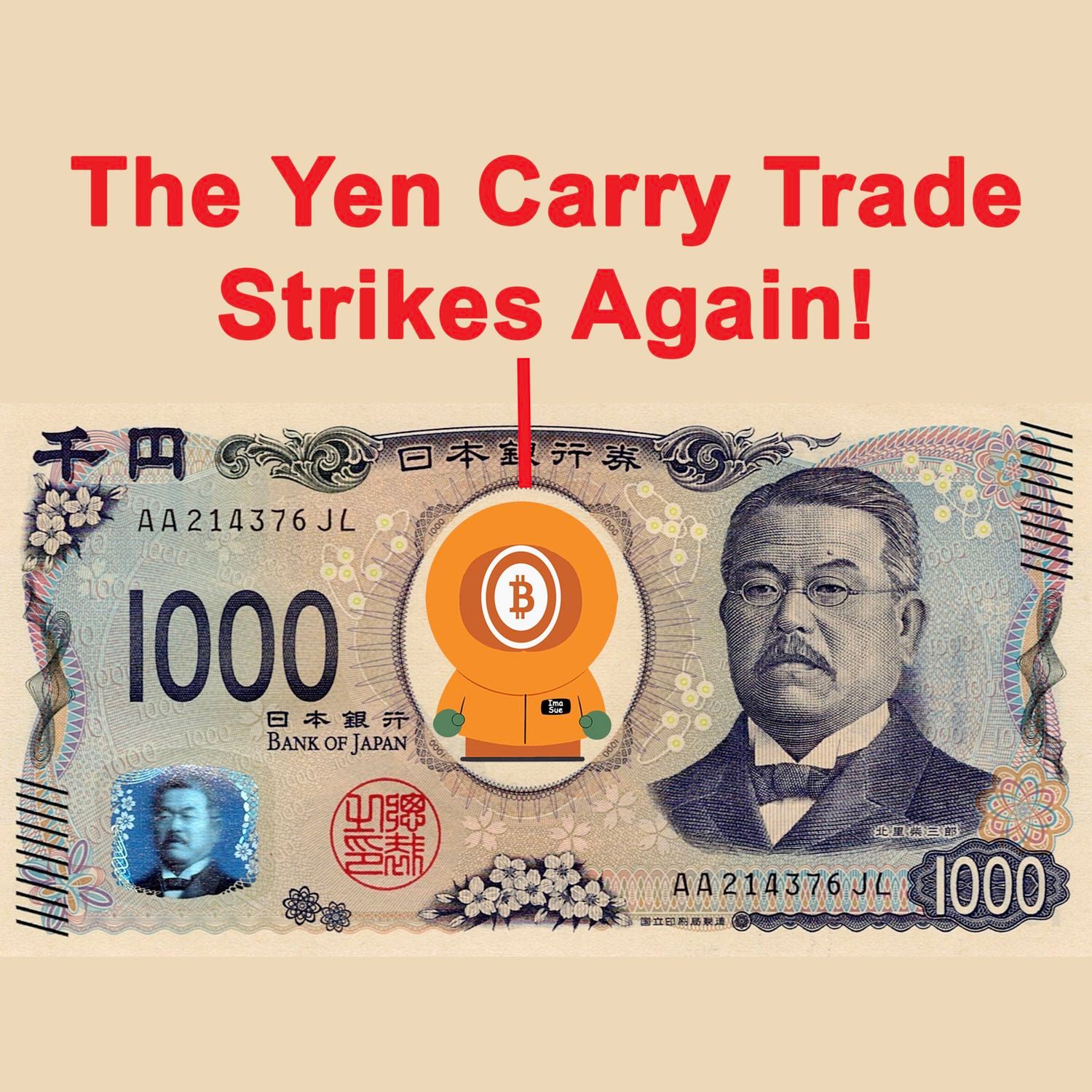
It is 09:40AM Pacific Standard Time. It is the December 2025. This is the last month of the year. And this is episode twelve twenty of Bitcoin and the yen carry trade reaches out and bitch slaps us again. If you wanna know what the hell's going on, chances are real good it's the yen carry trade coming back to haunt us. And if you remember, not last summer, but the summer before, the yen carry trade reached out and bitch slapped us across the Pacific again. So it's happening. That's that's what this this particular dip is about, the Yen Carry trade. We're gonna get into it a little bit more. Then we're gonna run down south to El Salvador, where we're gonna talk about simple proof is kinda teaming up with the El Salvadoran government.
And we'll I'll tell you all about it as well as Sony Bank. Sony Bank and their stablecoin. And then I'm gonna have a little reminder about Sony Bank causing problems a couple of weeks ago with a particular banking lobby group. And then then we're gonna talk about Genius Group. They've got a little report here about, Bitcoin treasuries and not in the way that you think are gonna talk about bitcoin treasuries. I I I promise. I I swear to you. Switzerland has proposed a, to delay a crypto tax, and then we're gonna run on over and talk about Tether, who is shuttering a mining operation, and I don't actually believe it has any damn thing to do with all the Tether FUD that we are having to endure. And of course, strategy will be in the news, as well as a hack on your finance, and then we're gonna finish up with yet another warning about not letting anybody know that you have Bitcoin. And if you do, well, for God's sakes, don't ever let them know where where you live.
But let's go back up front. The yen carry trade. What what what the hell am I talking about here? Well, I got this tweet from a guy named Shanaka Anselm Pereira, I think is how you pronounce it. Not exactly sure, but it it seems to fit. He's got a tweet here that says,
[00:02:28] Unknown:
Bitcoin did not crash. It was executed.
[00:02:34] David Bennett:
Kinda pausing there just to say, I don't appreciate the hyperbole as much as nobody else in my audience appreciates the hyperbole, but it's in the tweet, so I gotta read it. Continuing, the weapon, Japanese government bonds. On 12/01/2025, Japan's ten year yield hit 1.8777. The highest since June 2008. The two year bond touched 1%, a level not seen since before Lehman Brothers fell. This triggered the unwinding of the largest arbitrage trade in human history, the yen carry trade. Conservative estimates, 3,400,000,000,000. That's trillion with a t.
Realistic estimates, $20,000,000,000,000. For thirty years, the world borrowed free Japanese money to buy everything. Tech stocks, treasuries, Bitcoin. That era ended last month. The transmission was mechanical. Yields rise, yen strengthens, leveraged positions become unprofitable, selling begins, selling triggers margin calls, margin calls trigger liquidations, and liquidations trigger more selling. October 10, $19,000,000,000 in crypto positions liquidated in twenty four hours, the largest single day wipeout in digital asset history. November, $3,450,000,000 fled Bitcoin ETFs.
BlackRock's fund lost 2,340,000,000, its worst month since inception. And then December, another $646,000,000 was liquidated before lunch. Bitcoin's correlation with the Nasdaq, 46%. With the S and P 500, 42%. The uncorrelated hedge is now a leveraged expression of global liquidity conditions. Yet, the data contains a paradox. While prices collapsed, whales accumulated 375,000 Bitcoin, And miners cut their selling from 23,000 Bitcoin a month to a mere 3,672. Someone is buying what institutions are selling. The pivot point, December 18.
Bank of Japan policy decision. If they hike and signal more, Bitcoin tests $75,000 If they pause, a short squeeze could reclaim a $100,000 within days. This is not about cryptocurrency anymore. This is about the cost of capital in a world that forgot money has a price. The widowmaker came collecting, position accordingly, read the full deep dive analysis, and it's he's got a he he does have a full scale analysis here called the liquidity singularity that he published today, 12/01/2025. The link to this very lengthy report will be in the show notes along with all the stuff that I talk about today.
I directly paste all the URLs that I use. I'm not gonna read this report because it's well, it's not really a report. It's his thoughts on the matter because it's very, very long. I mean, I could do probably an entire half of a show just reading this one thing. So I'm not gonna read it, but I am gonna put the URL into the show notes so that you can have it. But going back to his actual tweet, there's a couple of things here that I think are interesting to note. He states that Bitcoin didn't crash, that it was executed because of the Yen Carry trade. I don't think Bitcoin was executed.
I do think, yeah, we're it's it doesn't make me all happy. You I'm not bouncing out the door, you know, go skipping down the street going la la la la la. I'm not doing any of that shit right now, but I don't think execution is the right word. However, I do believe he's correct about the yen carry trade. Because if you're borrowing cheap ass damn near free yen, and you're taking it to the foreign exchange and you're cashing it into dollars, or just using the yen directly to buy equities or whatever it is that you're gonna buy with it, and you're just gonna service that debt because it's sort of like taking out a loan, Right? You're kinda borrowing the yen, and you're just servicing the the interest rate on it. When that interest rate goes way above what you were planning it was gonna go above and you didn't position your risk accordingly, then you have to sell the assets so that you can pay back the yen that you effectively borrowed. And that's exactly what happened the summer before last. That's the the last real major ugly ass crash that we, you know, that we we've kind of experienced.
Well, except for, you know, October 10 and then what's been going on for the last couple of days. But then he says that whales, while this price has been collapsing and we're talking about this second tier, the one that started, you know, yesterday. Well, yesterday for me. I guess it was December 1 for him. I I have no idea where this cat lives, so it doesn't matter. But the whales, during this particular time, have accumulated 375,000 Bitcoin. They bought it on its way down. And miners stopped selling. They cut from 23,000 Bitcoin sold every month, and I guess that's cumulative amongst all the major miners, and they only sold 3,672.
Someone is buying what institutions are selling. But the line that I think is the most eloquent here is this one. This is not about cryptocurrency. This is about the cost of capital in a world that forgot money has a price. The yen carry trade has always been and like this guy says, for thirty years, for thirty years, we've been you know, investors have been getting in from the Japanese government, servicing the debt load on it because it was damn near free money, and using free money to exercise whatever options they're gonna buy. Real estate, they're gonna buy art, they're gonna buy, I don't know, equities. And the gains that are made on those assets are more than enough to service the debt load which was used to actually purchase those items or equities or whatever the hell we're we're calling them today.
And that's been going on for three decades. And then the chicken started coming home to roost the summer before last, and it looks like they've returned again as of today. So if you're wondering what the hell's going on, if you've heard conflicting stories about, well, what now? Because there wasn't anything in the news. We didn't bomb Iran. You know? The Russia didn't do anything different than they've always been doing. China's basically stable. There's really I mean, other than Trump quote you know, quoting Trump, I declare, you know, Venezuelan airspace now closed, end quote. Yeah. That's not enough.
There wasn't anything in the news cycle that really said, hey. Yeah. That's probably what it was. No. It's the yen carry trade. When you pop up to damn near 2%, which, you know, was coming up from damn near free money, that's gonna cause people to sell assets, and they're selling them all over the place. It's you know, even even legacy equity markets are not doing well today. So that's if you're wondering what the hell, well, that's the hell. Now let's go down south to El Salvador where they've partnered with Simple Proof to time stamp government documents on the Bitcoin blockchain. Juan Gault has it for Bitcoin Magazine. Simple proof.
The Bitcoin based document time stamping company recently announced official partnerships with El Salvador's Ministry of Foreign Affairs and Ministry of Environment to protect government records using the Bitcoin blockchain technology. The announcement was made during the eight or the Bitcoin Historico conference at the National Theater in El Salvador where CEO Carlos Torielli presented alongside Open Time Stamps creator and Bitcoin Core contributor, Peter Todd. The collaboration marks El Salvador's continued leadership in applying Bitcoin technology beyond financial application.
Both ministries have begun registering official documents on the Bitcoin blockchain with verified records now publicly accessible through dedicated government portals. Quote, Bitcoin is not just digital money. It's also a clock that no one controls. This allows us to certify with precision the exact moment a document was created, guaranteeing its authenticity and protecting the country's history forever. We're helping ensure that the country's history is preserved intact and can be verified directly on Bitcoin without intermediaries, said Carlos Toriello, CEO of Simple Proof, in a press release shared with Bitcoin magazine, pausing to say that's incorrect.
You do not know the exact moment a document was created. You do know the exact moment that document is referred to
[00:12:54] Unknown:
on the Bitcoin blockchain.
[00:12:56] David Bennett:
It could have been I could create a document five years ago. Bitcoin has no conception except for when I put that document on, quote, unquote, the blockchain. Right? So just be aware that that's that's an incorrect statement. The company has had multiple successful pilot programs in the past, including one in Screven County, Georgia in The United States and another in Guatemala where it had a direct influence on twenty twenty three elections. This deployment builds on Simple Proof's previous work in El Salvador where QBO plus program graduation certificates became the first public documents in the country registered via Bitcoin blockchain.
The Ministry of Environment's time stamp documents, including national reports and public files are available at blockchain.ambiente.gob.sv. The Ministry of Foreign Affairs verification of institutional reports and records can be found at rree.gob.sv/logrosememoria. Peter Todd, creator of Open Timestamps, the platform and protocol used in part of time stamp critical data on the Bitcoin blockchain said in a press release, quote, with a single transaction, we can protect millions of documents without congesting the network or altering its monetary function, noting that the system stores only cryptographic hashes rather than the actual documents on Bitcoin. So, no, they're not NFTs. Alright? So just the the the full document has not been loaded into the Bitcoin blockchain. It's only the hash, which brings up several other potential problems.
How do we know that that how hash matches the actual document? What was it the text of the document that was used to generate the cryptographic hash? Or was it a photograph what series of photograph pictures of the document where you can read the document and it was the pictures that were used to generate the cryptographic hash. I kinda wish they would detail that out because it's it's important. You get one you you get one thing wrong, like an extra space in text or you take a picture of the document again, none of the pixels are gonna match. You're gonna end up with a completely different hash. So this isn't just like take this pill and and all your problems are solved kind of issue. But no matter.
The project positions El Salvador as a global reference for using blockchain technology in government, information management, strengthening the transparency and public trust of democratic institutions and processes by eliminating the possibility of document tampering. Again, I I urge caution when we think about things like this. We really need to know the full parameters of exactly the procedure. I want the exact protocol being used to, quote unquote, time stamp a document on the Blockchain where the only thing that's actually in the transaction is the hash of the document. How did they hash it? When was the document created? How do we know that? What does the document say? How do we know that?
How did we get the hash? How do we know that? Exactly what time and in what method was the hash registered on the Bitcoin blockchain. I'm not saying that they're lying, I'm just saying with lack of information, it just it it just always raises the hackles on the back of my neck. But let's just take everybody at their word. This isn't a terrible thing. It's actually it's actually the it's better than bananas on the blockchain. Right? If there is a procedure and a protocol that can be relatively well, extraordinarily verified and then relatively trusted after that, it's the verification I'm I'm more concerned about. If we could verify the protocol on how this works and and just be able to see examples and examples and examples that all end up with the exact same hash, then I'd I'd actually be pretty happy. And it's not a it's not bad. I mean, what happens if your, you know, hall of records catches on fire? It's, you know, Library of Alexandria, anybody, you know, kind of thing. Although the Bitcoin blockchain would not have helped the Library of Alexandria because these documents are not full text versions on the Bitcoin blockchain. It's just the hash of what those documents said, and there's no way to actually know from the hash what they said.
The only reason the hash is important is that if I hash the same document twice and two different people do it, the hash should be exactly the same. And that way, we do know that that the contents of that document have, in fact, never been altered, and that's important. So let's move on to crypto payments coming to PlayStation as Sony plans their stable coin launch for 2026, Cointelegraph, Helen Parts. Sony Bank, the online lending subsidiary of Sony Financial Group, is reportedly preparing to launch a stablecoin that will enable payments across the Sony ecosystem in The United States.
Sony is planning to issue a dollar peg stablecoin in 2026 and expects it to be used for purchases of PlayStation games, subscriptions, and anime content, targeting US customers who make up roughly 30% of Sony Group's external sales. The Stablecoin is expected to work alongside existing payment options such as credit cards, helping reduce fees paid in card networks, the report said. Well, Sony Bank applied in October for a banking license in The United States to establish a Stablecoin focus subsidiary and is partnered with The United States stablecoin issuer, Bastion. Sony's venture arm also joined Bastion's $14,600,000 raise, which was led by none other than Coinbase Ventures.
Sony Bank's stablecoin push in The US comes amid the company's active venture into Web three with the bank establishing a dedicated Web three subsidiary in June, quote, digital assets utilizing blockchain technology are incorporated into a diverse range of services and business models, Sony Bank said in a statement in May. Quote, financial services such as wallets, which store NFTs, which are nonfungible tokens, and cryptocurrency assets and crypto exchange providers are becoming increasingly important, it said. The Web three unit, later named Blockbloom, aims to build an ecosystem that blends fans, artists, NFTs, digital and physical experiences, and both fiat and digital currencies.
Sony Bank's stablecoin initiative follows the recent spin off of its parent, Sony Financial Group, which was separated from Sony Group enlisted on the Tokyo Stock Exchange in September. The move was intended to decouple the financial arms balance sheet and operations from the broader Sony conglomerate allowing each to sharpen its own strategic focus. Okay. Do you remember a couple of weeks ago when I brought you this following headline? Community bankers ask the office of the comptroller of the currency in The United States to block Sony's crypto bank ambitions.
Uh-huh. Remember that? Well, if you don't, the lobby group of that is the Independent Community Bankers of America, the ICBA, National Trade Association representing small banks, they asked regulators to block Sony Bank's bid for a national trust charter to issue stablecoins. Well, it looks like Sony's gonna do it anyway. The writing is on the wall for these guys, and it's like an and I like small banks. You know, I really do. It is small banks that should be, you know, probably clawing their way into this into this thing instead of helping larger banks try to stop it while they do their own stablecoin issuance on the other side. This has all ever been about stalling the inevitable because they spent so much time pointing at us and laughing at us that they missed the boat on trying to figure out how to fundamentally understand what was going to definitely eat their lunch. It was just a matter of time when it did. Right? Well, it doesn't look like the ICBA has been effective.
It looks like Sony's gonna do this shit anyway. And even if they don't do it in The United States, Sony has a massive a massive fan base, user base, customer base. Right? Sure. It United States represents 30% of Sony. Well well, Sony external sales, but, yeah, we're not the we're not the only fish in the sea there. So it looks like Sony is going to trudge ahead. And if any of this stuff makes you feel kinda nasty, kinda dirty, go visit my friend SoapMiner over at soapminder.com. That's right. It's soapminder.com. That's soapminder.com where you can get soap.
It's all handmade. It's 100% grass fed beef tallow soap. It's got, like, the base soap has, like, three ingredients. It's a 100% beef fed towel or a grass fed beef tallow, distilled water, and lye. And he actually sells that just like it is as his what what does he call it? Rough cut? Yeah. Rough cut tallow soap has those three ingredients and no more. However, if you want a nice color, if you want, you know, a nicer fragrance, you can buy cedarwood. You can buy pine tar. These he actually has a goat's milk tallow bar. He's got lemongrass, orange clove, lavender, tea tree, peppermint, Earl Grey, redacted, which has got carbon in it with some one of my favorite soaps.
He's got body balms. He has deodorants. The man has two pages, two full pages. Well, not two full pages, but he's definitely got one full page and a second page of other stuff. He's got a lip balm, for instance. And he takes Bitcoin for it. If you want to buy your soap with Bitcoin, you can do it at soapminer.com. That's soapminer.com. Make sure you use discount code Bitcoin, and you will get a 10% off on your total purchase. That's Bitcoin and use it in the coupon code at soapminer.com. Go get yourself clean at soapminer.com. Genius Group.
How a BTC treasury can help solve humanity's final exam. The hyperbolic the hyperbolic nature of some of these things. But Genius Group's got a couple of good points. You know, terrible headline aside from CoinDesk. We'll just get into it here. It occurs very slowly and then all at once. American architect and venture inventor and futurist Buckminster Fuller once described the modern era of humanity as the final exam. To Fuller, this exam is not like the graded coursework that one would experience at a university, but instead a critical period in human existence where we will inevitably choose to exist in a utopia or cease to exist entirely.
Though no letter grade exists within the final exam, well, you get a d, Death, I guess. Fuller did detail a clear path toward passing into utopia, abandon technological selfishness for the collective use of technology to provide for everyone. In 2008, a few decades after Fuller's passing, Satoshi Nakamoto detailed the economic manifestation of this same test. As a neutral, mathematically enforced coordination layer, Bitcoin allows for the trustless collaboration of humanity at infinite scale. Open sourced and untethered to the central banks and nation states that control fiat currency, Bitcoin presented an opportunity for humanity to truly play through Fuller's world game and lead to a solution to pass the final exam.
At around the same time, social entrepreneur and futurist, Roger James Hamilton, was hard at work developing a solution to the final exam through the creation of the Wealth Dynamics system. Over the course of two decades, Hamilton's fundamental positioning as a futurist and coexistence with Bitcoin has culminated into Genius Group, a Bitcoin first education collective powered by AI. And, oh my god, it's listed on the New York Stock Exchange. Okay. Genius Group's mission is as unapologetically expansive as it needs to be to successfully pass Fuller's test, provide today's organizations, students, and entrepreneurs the necessary tools to coexist in the modern economy through the marriage of AI tools and an open monetary standard.
Through organized continuous learning communities, Hamilton's Genius Group is maximizing abundance to further collaboration. One of Genius Group's core principles is education. And GeniusU provides both a marketplace and real world environment for educational communities that reward value creation and borderless exchange of information in the modern age. Just as AI breaks down barriers to entry usually required to an or for an entrepreneur, it also creates an abundance of information needed to progress through the world game. Today, Genius Group serves 5,800,000 users in over 100 countries through its Genius model or sorry. Genius City model and online digital marketplace of AI training, tools, and talent.
Genius Cities, which act as global campuses for innovation, are on the rise. Earlier this month, Genius Group opened up their flagship Genius City Bali, marked by the inaugural Genius Future Summit held October. Genius Cities have opened up in Singapore and Dubai with additional plans to further globalize the Genius City movement in the near future. With personalized entrepreneurial AI pathways and an active community, Genius Group is combining human ingenuity and AI solutions to establish an educational foundation for the next generation of humanity.
As a Bitcoin first education company, Genius Group isn't limited in its goals to what it can offer others through a core belief that Bitcoin is an integral tool to work through the world game. Genius Group is also able to directly contribute alongside its community by establishing itself as a Bitcoin treasury company. Yay. During the Bitcoin investor day event at Paris Blockchain Week, Hamilton said that establishing Genius Group as a Bitcoin treasury company is a shift from competition to collaboration. In making efforts to purchase BTC, Genius Group is not only supporting other treasury companies, but also joining the coalition of many that view Bitcoin as a transparent value distribution system of universal consensus.
As a sponsor of CoinDesk's Bitcoin Treasury month, Genius Group is stepping up to be a visible proponent of Bitcoin and the future of humanity in a post final exam society. As technology advances, so does the opportunity to abandon technological selfishness for the collective use of technology to provide for everyone first slowly and then all at once. At no point does anybody say what the hell technological selfishness is? Are they I I mean, it's like, are they gonna use the term late stage capitalism that I've heard bandied about, like, for the last several well, at least couple of years, anyway.
Is it something else? I they never actually explain what the hell technological selfishness is. Although, I I presume they're talking about private companies building technology like OpenAI and not giving it away for free. That that that that's technological selfishness. And somewhere in here, they also mentioned something about, oh, intellectual property. Guys, why would I write a book if I wasn't able to get the the money from it? Why would I come up with something if I wasn't able to get paid for it?
[00:30:21] Unknown:
I I I don't under I don't understand the vehemence
[00:30:28] David Bennett:
of the the hatred of intellectual property because guess what? Without it, you're gonna have far less innovation. Now, does does that mean that that I'm a big fan of Elon Musk? No. I mean, at one point or another, there's only so many yachts you can ski behind, but that's not up to me to tell somebody else what that number of yachts is. I I can't go to Sailor and say, dude, you got three yachts. You know what? Two is fine. You're gonna have to sell your third. A, he's gonna laugh at me. B, where do I come up with this number? It it's like it's there there was a
[00:31:08] Unknown:
there was a famous United States Supreme Court case on Larry Flint.
[00:31:14] David Bennett:
And if you don't know who Larry Flint is, I advise you to watch the movie people versus the people versus Larry Flint. It's got Woody Harrelson is playing Larry Flint. Larry Flint is the guy behind Hustler magazine, and there's a difference between nudie magazines. Playboy and Penthouse are sort of, like, upscale, more classy. I don't know. I haven't seen one in years. I've I've heard that the the quality has degraded in Playboy since the homeboy the owner died, but or what? Hef Hugh Hefner since he died. But I don't know. I haven't seen anything like that in decades. But the way that it used to be was this. Penthouse and Playboy were high class, upscale,
[00:31:55] Unknown:
very tastefully done, nudie pictures of women. And then you had Hustler.
[00:32:03] David Bennett:
Hustler was not classy. Hustler was like like redneck, definitely did not paint women in a good light at all. It was harsh and it still is. It was I mean, people say, oh, well, Playboy's pornography. Nah. No. But here's the deal. In a couple of cases or at least one case of Larry Flint that was taken to the Supreme Court, one of the Supreme Court justices was they the question that was put to the Supreme Court was, how do you find define pornography? And the answer from this judge was, I don't know how to define pornography, but I know it when I see it. And that's sort of where I'm at with, hey.
You got three yachts. Then maybe that's too many yachts. Hey. You got 15 houses. Maybe that's too many houses, especially if you're not renting them out. If you're if you're not using them as like an like an investment to, you know, make actual cash on a month over month basis, if you're just using it for storage of wealth, you're not renting them out, you see them maybe once every, you know, every one of them once every ten years, it's probably a little bit excessive. But again, this is there's two things here. Not only is it me saying, I don't know what too rich is, but I know when I see it. And second is,
[00:33:26] Unknown:
who am I to call those shots?
[00:33:29] David Bennett:
I'm I'm I'm not anybody. I can't call those shots.
[00:33:33] Unknown:
I would hope at one point or another some of these people would go, oh, you know what? Maybe, you know, maybe I'm done. Maybe I can just go enjoy my life. But
[00:33:45] David Bennett:
humans are gonna human. And while I appreciate what Genius Group is doing here, I think we need to stop being as naive as we have we have allowed ourselves to become. We've been apathetic forever, but it seems like Bitcoiners, you know, like, we started be we started being apathetic, and then we came into full knowledge. But over the last, like, three or four, maybe five years, we've become a little bit more naive than than I think is is credible. And I think we need to stop doing that shit right now. You know what? Let let's run the numbers. CNBC Futures and Commodities, well, at least all things are normal in Energyland where Brent Norsee is up 1.12% to $63.00 8 a barrel.
West Texas Intermediate up even more, 1.16% to $59.22. Natural gas is acting as a hedge, so all things are right with the world in energy. It's down a half point to $4.82, so it's still still pretty damn high. I guess we're gonna have a a mighty cold winter this year. Gasoline is up two and a half points, getting ready for Christmas driving. $1.86 a gallon. The Murbon crude, everybody's favorite light sweet crude is up one and a quarter to $65.00 7. Metal futures are mixed. Palladium is down 1.7%, but gold is up a third to $42.70 in two dimes. It's pushing against its all time high.
Platinum is down a third. Silver is up 3.37. It's almost to $60 an ounce, y'all. $60 an ounce on silver. Copper is up point 56% at this time. Ag is mostly in the red today. The biggest winner is chocolate, point seven six percent to the upside. Biggest loser today is sugar. Three full points to the downside. Live cattle down 1.1. Lean hogs basically moving sideways and feeder cattle down one full point. S and P is down one point no. No. I'm sorry. 0.17. Nasdaq is down 0.09. The Dow is down a third, and the S and P Mini is actually up today, not much, 0.05%.
And then you got Bitcoin, which is knocking on $85,370. That's a 1,700,000,000,000 market cap, and we can only purchase 20.1 ounces of shiny metal rocks with our one Bitcoin of which there are 19,956,138.66 of an average fees per block or low 0.02 BTC taken in fees on a per block basis. However, at the moment, fees are pretty high. Well, relatively. There's about 27 blocks carrying 55,000 unconfirmed transactions waiting to clear at high priority rates of seven sats per v by low priority is gonna get you in at five. And mining, or have we lost this? No. We have not lost Zeta Hash, range. We are at 1.08 Zeta Hash's per second in hash rate on the Bitcoin blockchain. That's more security than you'll ever need and more. From Lone Star Bitcoin, which was Wednesday's episode of Bitcoin, and I apologize because I didn't come to you Friday. I really thought I was gonna be able to pull that off, but, man, tryptophan is one hell of a drug, dude. And you eat like anything, like any turkey leftovers, and your whole day is pretty much shot. I'm I'm just telling you. So I didn't come to you on Friday. And again, my apologies. But Oak Grove with a 100 sat says, for what it's worth with Spain, the socialist opening salvo in that war was to butcher half of the priests and nuns in all the churches there.
Take that for what it is. Yeah. The whole Spanish revolution thing or civil war, whatever the hell it was called, the the Franco Fracas is I've heard that used before. Bad deal all the way around. Very, very bad deal. Spitball Marksman. Wow. 10,000 sats, bro. Thank you. He says, Thanksgiving sats and stuffing. It's a transition round here. I get what you did. Oak Grove with one two six two from episode twelve nineteen says the IMF. That is explained in the book. How they could how they would enforce that. Texas is one step closer to being its own country again with Sam Altman. Remember that Skynet registered the DNA of all captured humans as part of intake.
So ask yourself, am I making Skynet's job easier? I think the answer to that Oak Grove is yes. I think we all are. We're trying not to, but we're being we're being corralled, man. We're we're being corralled just like fucking cattle. Nick Dose with a row of sticks one one one says, cheers. Nostra gang with one zero two says, happy Thanksgiving. Happy Thanksgiving to yourself, bro. Sat Cummins, 5,000, bro. Thank you. Says, I love this show. Well, I love you, Sat Cummins in pies. One twenty one. Thank you, sir. No. Thank you. And then here in Gone says, I hope that all the companies and people who rejected Bitcoin when it started dipping, because that seems like the trend here, get just as rejected when it starts mooning again and breaks off the legacy system. We need a Jack Mallers versus Jamie Dimon celebrity death match.
That would be pretty funny. I gotta admit, that would be pretty fun to watch. Alright. That's the weather report. Welcome to part two of the news that you can use. Tether is gonna shutter their air Uruguay Bitcoin mining operation. Matt DeSalvo from Decrypt is gonna tell us all about it. And it says, Stablecoin issuer Tether is halting its Bitcoin mining operations in Uruguay. The firm, which issues Tether, the third largest cryptocurrency by market capitalization, said it made the decision to leave the South American country due to high energy costs. Local media reported that El Salvador based Tether had confirmed to Uruguay's minister of labor and social security that it was laying off 30 of its 38 employees inside the country. The firm also confirmed the exit to CoinTelegraph.
And, of course, all questions for Tether went unanswered. Back in September, local media reported that Tether, which in October reported $10,000,000,000 in profit for the 2025, was in dispute with Uruguay's government owned power company, UTE, over a $5,000,000 debt. Tether issues USDT, the most traded digital coin in the crypto world, and the third largest digital asset with a 184,400,000,000 market cap. The token is dubbed a digital dollar. Yeah. Yeah. Yeah. We we all we get that. Let's get back to this one. But Tether also wants to be the world's biggest Bitcoin miner according to Paolo Ardoino, the CEO. And South American countries have been eyed up by Bitcoin miners due to their cheap energy.
Now the crypto mining industry requires huge data centers full of expensive computers, yada yada yada. Tether is making further inroads into Latin America after relocating to Bitcoin friendly El Salvador back in January. The company bought a majority stake in South American agricultural firm, Adecoagro, in March, and I brought you that news here on the Bitcoin and podcast. So there seems to be some dispute as to why Tether is leaving Uruguay and the mining operation there. And it seems to be that Tether's saying that energy prices are just too damn high, and Uruguay seems to be saying that Tether owes them $5,000,000.
Who knows who's right? What's important here is all the fuds surrounding tether that we're seeing, and it's gonna get worse. Right? So let's let's before I talk about that, the fud that's gonna come out is that tether is dying. Of course, that's already out, but but this is gonna be a concrete example that people like Peter Schiff will hold up and say, here's proof that Tether is dying. They can't even keep their mining operation alive, or they can't afford to pay a $5,000,000 debt, or they can't afford high energy prices. Pick your flavor, dude. The lollipop has the same amount of sugar depending on whether it's chocolate, vanilla, or, I don't know, cherry. It's gonna be used against Tether, which nobody really cares about Tether itself.
Right now, the people that hate Bitcoin have a full blown open highway into FUD between Tether, between the price action that we've seen, we're down, like, 40% or is either somewhere between 3540% from all time highs. You and I have been here before. However, these guys don't they even the even the guys that are doing the FUD, they've been here before. They but they look at it as like, oh, it's the combination lock. This combination always works. We just all we have to do is wait a while. Bitcoin's price falls 35%. We we already got a couple of scapegoats that we keep in our back pocket, and we're gonna not only scapegoats, but, like, you know, more problems.
And Tether is being touted as this major problem. You've got, I can't, like, right now, it's really hard for me to get on Twitter and look around, which is why I stay on Nostra most of the time. But it's really hard to look on Twitter because all I see is all these people with all these numbers saying, here's how Tether is going to to die. And, of course, as always, it's gonna take Bitcoin with it. And we've been here since the the the Twitter account called Bitfinex, e d, at the very end, like Bitfinex and then e d. Because this guy this guy was against Tether ever since the beginning.
Swore up and down that the only reason Bitcoin's price and we're talking back when it was, like, $17,000 a coin. Bitfinex was yelling at the top of his lungs that it was all because Tether, and that Tether was gonna fail, and it was gonna take Bitcoin to zero. We've heard it all before. Everything that we're seeing today and all the things that we've seen in this decline from a $126,127,000 dollars is exactly the same shit in the exact same order that we've seen every other 35% fucking drop, and I've seen, like, 12 of them. This is nothing new.
And yet, here we are again with the media poised, perfectly poised as they have been on several occasions before to put the nail in the coffin of Bitcoin once and for all. And as usual, it's not going to happen. I just it just boggles the mind that we're still here. Whatever. Let's move on to strategy.
[00:45:49] Unknown:
Guess what? They bought more Bitcoin.
[00:45:54] David Bennett:
Now now now now. They they actually I think what they did is they just wanted to buy enough Bitcoin to hit a particular number. So they bought a 130 Bitcoin Bitcoin for $11,700,000, and their total holdings hit exactly 650,000 BTC. But here's the real news. They've established a 1,440,000,000 dividend reserve in cash, not in Bitcoin, but in USD. Let's read why because this is another end of the FUD. This we've been hearing about its strategy, and it's gonna be Tether, and god only knows who else they pulled out of their hat. But the block and James Hunt has the whole story. Bitcoin treasury company strategy acquired an additional 130 Bitcoin for 11,700,000.0 at an average price of 89,960 per Bitcoin between November 17 and November 30 according to an eight k filing.
Strategy now holds 650,000 BTC for an average price per coin of $74,436. The latest acquisitions were made using proceeds from at the market sales of its class a common stock MSTR. So they diluted their shareholders again. But according to Saylor, as long as their Mnav is above the number one, it's not really dilution to print up more shares and and and sell them. I disagree, but I'm not a billionaire either like he is, and he's got the three yachts that I keep bitching about, and I don't. So there you go. Take whatever it is that I say with a grain of salt. But during the last two weeks, strategy sold 8,200,000.0 MSTR shares for $1,480,000,000.
And as of November worth of MSTR shares remain available for issuance and sale under that program. No shares of its various perpetual preferred stocks were sold in the period with a collective $30,200,000,000 remaining under those ATM programs. Listen up. Additionally, strategy announced a United States dollar reserve of 1,440,000,000.00 to support the payment of dividends on its preferred stocks and the interest on its existing debt funded by the MSTR at the market sales. Quote, strategy's current intention is to maintain a USD reserve in an amount sufficient to fund at least twelve months of dividends, and strategy intends to strengthen the USD reserve over time. With the goal of ultimately covering twenty four months or more of its dividends, the maintenance of the of the USD reserve as well as its terms and amount remain subject to strategy's sole and absolute discretion and strategy may adjust the USD reserve from time to time based on market conditions, liquidity needs, and other factors.
Okay. So they say that they're gonna use it just to pay dividends, and then they say, well, given other factors, we may use it for liquidity. What does that mean? Make payroll and pay bills and pay vendors. You know, liquidity. You need so, again, let's be careful and not get too naive. Let me finish up first, though. Last Monday's strategy appeared to have paused its weekly Bitcoin acquisitions after failing to announce any new buys with its total holdings remaining at 649,870 BTC. However, given the November 17 to November 30 date range in Monday's filing, it's unclear exactly when the latest acquisitions were made. That followed what Sailor described as a big week the week prior, announcing the purchase of another 8,178 BTC for 835,600,000.0 instead of his usual acquisition hints.
Saylor posted an update on strategy's Bitcoin tracker on Sunday stating, what if we start adding green dots, Likely referring to the new $1,440,000,000 or US dollar reserve for dividends and interest payments. Quote, establishing a USD reserve to complement our BTC reserve marks the next step in our evolution. And we believe it will better position us to navigate short term market volatility while delivering on our vision of being the world's leading issuer of digital credit, Saylor said on Monday. Okay. Let's see if there's anything of note here. Yeah. Yeah. Earlier in November, Saylor also struck a defiant tone pushing back against the idea that it may be removed from MSCI indices amid the stock sell off.
JPMorgan analysts had warned that strategy could see billions of dollars leave its stock if MSCI removed it from major equity indices. Strategy is currently included in indices such as the Nasdaq one hundred, MSCI one USA and MSCI World, effectively allowing Bitcoin exposure to seep into both retail and institutional portfolios via passive investments. And then they talk about JPMorgan going on the warpath, which I already covered, I believe, on Wednesday. But here here's the thing with it the reason I'm bringing you the sailor news is this. It's not that he bought more Bitcoin. That's what he bought was a pittance. No. No. No. It's this treasury reserve.
But it's not even that. It's the timing of the creation and the announcement of the 1,440,000,000.00 US dollar reserve to protect future dividends for a twelve month period. What happened yesterday? What happened yesterday? Does anybody remember? Yeah. There was a podcast that had Fong Li, the current CEO of strategy, on as a guest. And you know what he did? That dipshit unzipped his fly and said it's possible under certain circumstances that we could sell some Bitcoin. And then you see the rip into the red on the downside price action for Bitcoin. Even though I've already talked about it being the Japanese yen and the carry trade thing being part of it, this did not help.
This was adding fuel to a fire that was already burning. So, here's my question. We didn't know a damn thing about this $1,440,000,000 USD fund to protect dividends until after news broke that Fong Li has stated, quote unquote, this is the media, quote unquote, by God, strategy is gonna sell their Bitcoin. Fong Li said so.
[00:53:13] Unknown:
A, he didn't say so. B, he gave a couple of conditions under which they might sell some, and c, that was a bad move. What what would it take to get somebody to go on a podcast and shut the fuck up about something like that. Because that was in clear contradiction to what Michael Saylor has always said. Right? You got two leaders of a company. When Michael Saylor was CEO
[00:53:41] David Bennett:
and now as chairman of strategy, he said the same thing in both while he was occupying both of those seats. We will never sell Bitcoin. He said it multiple times a year, couple of times a month. He was always asked, well, under what conditions would you sell Bitcoin? His answer was always, we're not. We'll come up with the money in some other way, but we're not selling our Bitcoin. And he did that for five years. Until yesterday, when Fong Li decides, as CEO of strategy, to go on a Bitcoin podcast and say, well, under certain circumstances, we might sell some Bitcoin. That's not leadership, or rather, it's not coherent leadership.
And I don't know what should scare investors more. The fact that Fong Li said what he said or the fact that the two main guys that are calling his shots at strategy don't seem to be reading from the same playbook. That, to me, is actually more scary than what either one of these jokers actually say. The fact that they're saying a different thing is my problem. Does that mean that I'm going to sell all my strategy stock? No. Because I don't own any. I never bought any. I never wanted it because all I really wanna do is just have more Bitcoin, and I'm not gonna be able to do that by buying strategy stock.
It doesn't work that way. And people who think that they're gonna you're getting exposure to price action and nothing more to Bitcoin when you buy any of this shit. Any like, in any stock for a treasury company, if you wanna get price exposure to Bitcoin, you just buy Bitcoin. It is really that simple. And I I don't understand it. But going back to this this incoherent speech between these two individuals, can I just say, please, Michael Saylor and Fong Li, would you do me a favor? Sit down, have a nice glass of whiskey each. Neat. No ice. Room temp, the way whiskey was supposed to be served.
And finally figure out what page of the playbook you're on. Because you don't seem to be either reading the same playbook, and if you are, you are not on the same page. Get your ass on the same page. And then we can talk about yearn. Oh, thank god. We can talk about something fun. Yearn Finance, y ETH, suffers a major hack. Attackers send $3,000,000 worth of ETH to tornado cash. This is out of Yahoo Finance because nobody else is writing about this in the crypto world or the Bitcoin world, like all the magazines that I normally see. I scavenged all of them. I'm sure there are stories now, but this morning when I was putting the show together, nobody was saying nothing about yearn.
And this shit happened last night. Before I went to bed, I read about this crap. Anyway, DeFi platform Yearn Finance's YETH product was hit by an unlimited minting of tokens on Monday, draining the entire y eth pool in a single transaction. I've warned everybody as much as I can about defi. Stop. God. It's like, how hard is this? How hard is this? You know why I don't worry about any of this? Because I I don't play with any of this crap. I never have to worry about waking up to news like this, ever. I've never had to, and I never ever will. But according to blockchain data, the exploit generated a near infinite number of yETH draining millions from balancer pools. Attackers roughly profited 1,000 ETH worth $3,000,000, which was routed through the Tornado Cash Mixer according to Chinese journalist Colin Wu.
YETH is an index token consisting of several different liquid staked versions of ETH. In other terms, Ethereum liquid staking derivatives. Because we everybody needs a derivative. Everybody needs everybody needs a a casino version of a real thing. A derivative oil derivatives is a casino version of oil. Alright? So you hear the word derivative, you might as well just spell it casino because that's what it is. It's not price discovery. It is worthless gambling bullshit, and you need to stay as far away from it as you possibly can. Because otherwise, you're gonna end up with stories like this.
The incident apparently involves several newly deployed smart contracts, which then self destructed after the transaction. The total financial losses remain unclear. However, the yETH pool had a total value of around $11,000,000 prior to the attack. Following the exploit, mixed reactions came from the community with some expressing concern over the continued use of outdated contracts. Besides, Yearn Finance suffered a hack in 2021, affecting its YDAI vault and losing $11,000,000 in value back then. The hacker apparently got away with 2,800,000.0 at that time, and later, that protocol flagged a faulty script in December 2023, wiping out 63% of a position in its treasury.
And people are going they're they're still going to go use this thing. Even after all of this,
[00:59:39] Unknown:
they've been, like, I mean, this like, this we're talking about hacks back to 2023, dude.
[00:59:45] David Bennett:
Stay away from this stuff. Please, for the love of God, stay away from it. And then, finally, the word of warning, and I'm I'm not going to read this story, and you'll figure out why very quickly with the headline. By the way, just to let you know, it's from Bitcoin News, and it's written by NEMA. British Columbia family tortured, sexually assaulted in a $1,600,000 Bitcoin theft. So some people broke into a family's home in British Columbia, tied up the mother, the father, and their daughter. I'm not going to get into it. It does not look like the two women were raped, but they were sexually or at least one of them was sexually assaulted.
And I'm not going to read the story because I don't want to trigger anybody this early in the week, this early in the day.
[01:00:45] Unknown:
Please stop wearing swag. Stop telling people how much Bitcoin you have.
[01:00:55] David Bennett:
Or if even if you're even if you're a shit coin or I don't care man. I don't want you dying either. Don't tell people how much ETH you have. Don't tell much people how much dye you have. Don't tell just don't tell anybody anything. In fact, you should probably not tell how much people are people how much gold you have. You should probably not tell people how much you make. You probably shouldn't tell much how people how much you have in your bank account. You probably shouldn't do any of that. Right? So so stop. But what especially when it comes to Bitcoin because these these wrench attacks are on the rise. These guys actually got away with $1,600,000.
They initially wanted 200 Bitcoin from the guy. The dude said he didn't have that much Bitcoin. They lowered their price to 100 Bitcoin. Bad shit started happening when he said he couldn't pay that either, and then he ended up, I think, giving him, like, 20 Bitcoin or something like that. It doesn't really matter. They broke into his home. They were were they they were disguised, weren't they?
[01:01:56] Unknown:
They were waterboarded. They were that's how that's part of the torture that they that they, you know, that happened. They were waterboarded. And by the way, this was done by two men dressed as Canada post workers. I guess that's like the postal service in Canada.
[01:02:16] David Bennett:
So a couple of mailmen here in The United States comes, knocks on your door. You open it. Why? I don't know. Look through the peephole. If you see if you see the mailman knocking on your door and there's two of them, you might wanna ask yourself why because in The United States, typically, I've only ever ever seen one mail person unless there was two and they were being trained. But I'm just saying it just seems odd. Right? Mailmen, they will they don't really knock on your door to deliver the package. They just leave the package on your doorstep, but generally they don't even do that, man. I mean, like, unless it's like in a a US postal service thing. Right? There you know, it's very rare. If it doesn't fit in the the mailbox, they kinda don't you kinda don't worry about it. But they certainly don't knock on your goddamn door.
It did so the the guy opens the door, they push their way in. They they just push their way in, and then all hell breaks loose. Over $1,600,000, which is a lot of money. I get that, but still, it's it's worth your family.
[01:03:24] Unknown:
Just
[01:03:25] David Bennett:
please.
[01:03:28] Unknown:
Please. Please.
[01:03:31] David Bennett:
And I know there's some of you out there that may be listening to the show that's that are saying, dude, I I make money selling I make my money selling Bitcoin shirts. I get it. I do. If you wanna buy a Bitcoin shirt, then by all means, buy one. Just don't wear it in public. Right? Don't wear it in public. I know that sounds stupid. Why would I buy a shirt if I'm not gonna wear it? In this case, support your local Bitcoin vendors who make Bitcoin shirts by buying one of their Bitcoin shirts, but don't wear it in public. That goes for socks, for pants, for suit jackets, and ties, and hats, and glasses, and rings, and bling, and all kinds of shit is being made that has the great big ass Bitcoin symbol on it, and almost everybody knows what that symbol means now. It didn't used to be that way, but we've been effective in marketing at least to that point to the point that if you wear it in public, you are a target.
This guy this guy let's see. Hold on for a sec. Because there was something in this in this maybe it's in the last expert or last, paragraph. Well, somewhere in here, it it it stated that the guy was was basically bragging about how much Bitcoin he had in public to other people. And that's why, you know, in that case, he wasn't wearing bling. He was just opening his great big ass mouth. Don't do that. Please don't do that. I've seen some really good Bitcoiners make the mistake of saying how much Bitcoin they had on a podcast, and once you say it, you can never take it back.
Don't do that. I wanna see you safely, and I wanna see you on the other side. This has been Bitcoin, and and I'm your host, David Bennett. I hope you enjoyed today's episode and hope to see you again real soon. Have a great day.
Opening, episode setup, and market dip teaser
Market check: energy, metals, ag, equities, and Bitcoin metrics